
Picking the wrong belt costs more than the price of the part. The wrong profile slips under load, runs hot, and fails early. On a timing drive, the wrong belt can destroy an engine. This guide covers the three belt families you will actually specify, how to read a belt code, and how to match a belt to the job — so you order once and the machine stays running.
Start with how the drive moves power
There are two ways a belt transmits power, and the difference decides everything else.
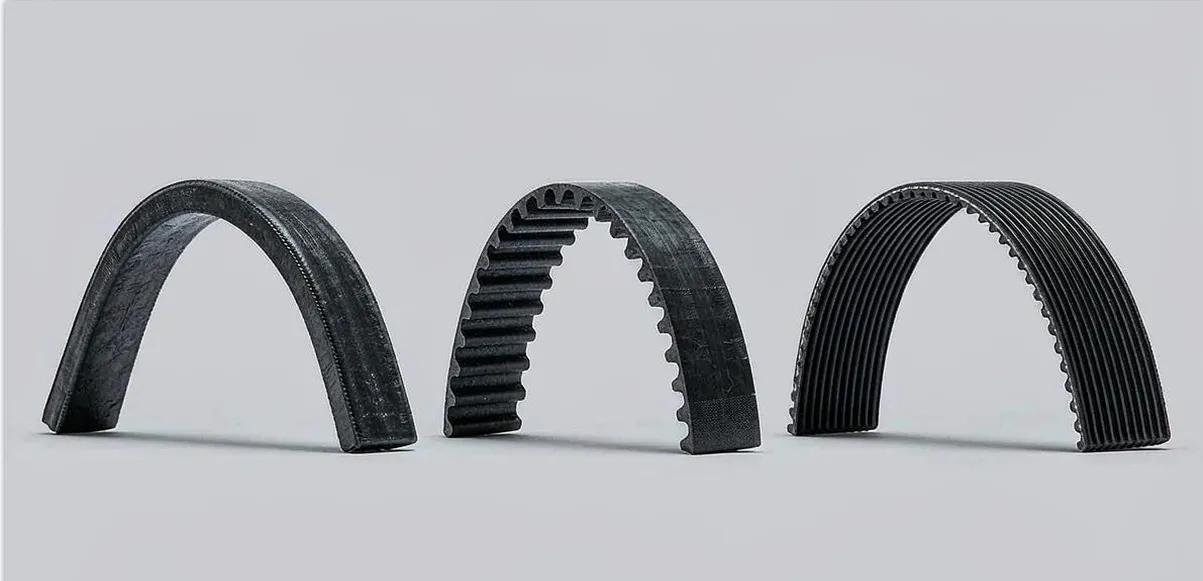
Friction belts — V-belts and poly-V belts — grip by wedging into the pulley groove. They are simple, cheap, and they slip when overloaded, which protects the machine from shock. That slip is a feature, not a flaw, on most industrial drives.
Synchronous belts — timing belts — use teeth that mesh with sprockets. They do not slip, so they hold an exact ratio. You need that when valve timing, indexing, or precise positioning is on the line.
If you remember nothing else: slip is fine for general power, fatal for synchronization.
V-Belts: the workhorse
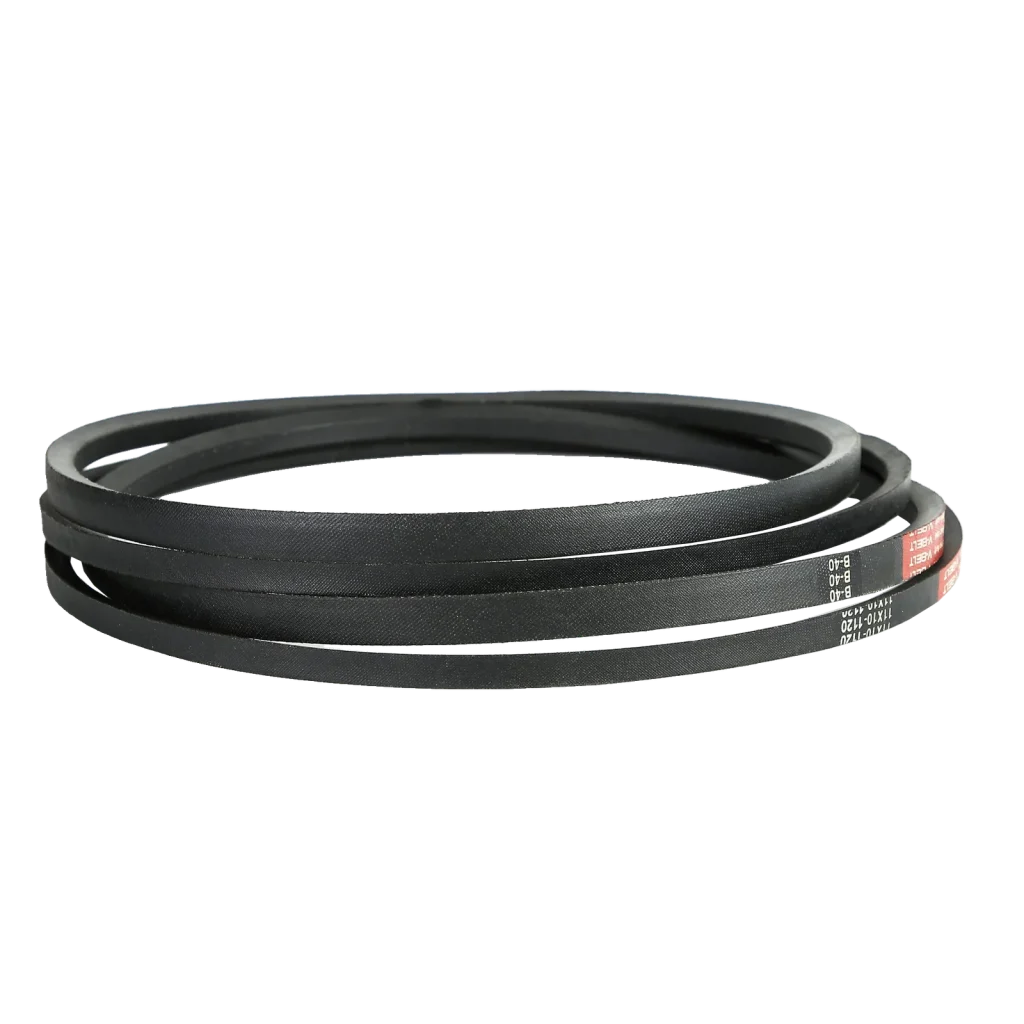
The V-belt is a trapezoid that wedges into a matching sheave groove. More load pushes it deeper and increases grip. It is the default choice for industrial, agricultural, and HVAC drives.
Wrapped vs raw-edge cogged
- Wrapped (classical) belts have a fabric cover. They run quieter and cost less, which suits steady, low-speed applications.
- Raw-edge cogged belts expose the rubber and add notches on the underside. They flex around small pulleys, run cooler, and carry more power in the same space. Use them on high-speed drives, small pulleys, or where heat builds up.
Classical vs narrow sections Classical sections (A, B, C, D, and the metric Z, A, B, C) have served for decades. Narrow sections (SPA, SPB, SPC; 3V, 5V, 8V) move more power in a smaller footprint and resist stretch better. When space or load is tight, go narrow.
Where they fit Pumps, compressors, blowers, conveyors, mowers, and mixers all run on V-belts. Browse our V-belt range or see them applied across industrial, agricultural, and HVAC equipment.
One rule that saves drives: never mix belts. Do not pair an old belt with a new one, and do not mix brands on the same drive. Uneven lengths mean uneven load, and the shortest belt carries the most — until it breaks.
Timing Belts: when slip is not an option
A timing belt is a toothed loop with fiberglass or aramid tensile cords set in a rubber compound (neoprene, HNBR, or EPDM). The teeth lock into sprockets and hold position to a fraction of a degree.
You reach for a timing belt whenever the driven shaft must stay locked to the driver:
- Engine cam timing (where a break bends valves on interference engines)
- Indexing conveyors and packaging lines
- CNC and precision positioning
Two tooth profiles matter. Trapezoidal (MXL, XL, L, H, XH, XXH) is the older standard. Curvilinear (HTD, STD, RPP) has rounded teeth that handle higher torque with less noise. For new designs under load, pick curvilinear.
See our timing belt options. Note that timing belt service is normally a kit job — belt, tensioner, idler, and often the water pump — because they wear on the same clock.
Poly-V (Serpentine / PK): compact and multi-accessory
The poly-V belt, also called a ribbed or serpentine belt, runs several thin ribs lengthwise. It keeps the wrap and flexibility of a V-belt while behaving like a flat belt, so a single belt can drive alternator, power steering, A/C, and the water pump from one crankshaft.
In cars that is the serpentine belt. The same idea shows up in appliances, fitness equipment, and industrial machines with several accessories on one shaft. Profiles are named by rib pitch — PH, PJ, PK, PL, PM — with PK the common automotive size.
Explore poly-V belts and where they run in automotive drives.
The specialist belts
Two categories sit outside the three above and are easy to confuse:
- Motorcycle and CVT belts are built for continuously variable transmission — variable speed, not fixed ratio. They are specific to scooters, ATVs, and some snowmobiles. See motorcycle belts.
- Custom and specialty belts cover nonstandard profiles, heat- or oil-resistant compounds, conductive (antistatic) builds, and bonded constructions. Start a custom project when the catalog does not fit.
How to read a belt code
The part number tells you the profile and length. Decoding it prevents the most common ordering mistake.
- V-belt: a section letter plus inside length in inches.
A60is an A-section belt with a 60-inch inside length. Metric readsSPA1250(SPA section, 1250 mm pitch length). - Timing belt: teeth count and pitch, or pitch length.
114MXLis 114 teeth of MXL pitch;HTD 800-8Mis 800 mm pitch length at 8 mm pitch. - Poly-V: rib count, pitch, and effective length.
6PK1003is 6 ribs, PK pitch, 1003 mm effective length.
Always confirm two things: the cross-section and the length. If the old belt is legible, cross-reference it. If not, measure the pulleys and span, or send us the application and we will match it.
Match the belt to the job
| If you need… | Best belt | Why | Typical use |
| Exact ratio, indexing, cam timing | Timing belt | No slip, fixed position | Engines, packaging, CNC |
| One belt, several accessories, quiet | Poly-V | Multi-rib wrap, compact | Car serpentine, appliances |
| General power, shock loads, easy upkeep | V-belt | Slips safely, cheap, simple | Pumps, compressors, mowers |
| Variable speed transmission | CVT / motorcycle belt | Ratio changes with load | Scooters, ATVs |
Material and construction decide lifespan
The profile gets the headline, but the compound and cords decide how long the belt lasts.
- Compound: EPDM resists heat and ozone; HNBR handles oil and heat (common in timing belts); neoprene is the legacy standard; chloroprene similar.
- Tensile cord: polyester is the default. Aramid (Kevlar) is near non-stretch and shock-proof — specify it for agriculture and debris-prone drives. Glass fiber is standard in timing belts.
- Build features: cogs improve flex; back fabric cuts noise; special coatings resist oil, static, or abrasion.
For outdoor power equipment and construction, ask for Kevlar-reinforced or cut-resistant construction. It is the difference between a belt that snaps on the first stone and one that finishes the season.
Why buyers specify KingPower
KingPower manufactures V-belts, timing belts, poly-V belts, and custom drives at an IATF 16949-certified plant, with 1,000+ specifications and private-label supply for distributors and OEMs. If you are building a belt program or replacing a discontinued part, start a project or read about the factory.
FAQ
Can I replace a timing belt with a V-belt? No. A timing belt holds an exact position; a V-belt slips by design. Only a synchronous belt can do a timing belt's job.
What is the difference between a V-belt and a serpentine belt? A V-belt is a single trapezoid wedging into one groove. A serpentine (poly-V) belt has multiple ribs and wraps several pulleys at once to drive multiple accessories.
How do I find the right belt size? Read the code on the old belt first. If it is gone, measure the pulleys and center distance, or give us the machine and application and we will match it.
Are poly-V and V-ribbed belts the same thing? Yes. "Poly-V," "V-ribbed," and "serpentine" describe the same multi-rib concept; PK is the usual automotive profile.
Should I buy belts by brand or by specification? By specification, and always as matched sets for multi-belt drives. Mixing brands or old and new belts shortens the life of the whole drive.
Bottom line
Match the belt family to the function: timing when nothing can slip, poly-V when one belt must drive several accessories, V-belt for general power. Read the code, buy matched sets rated for the environment, and the drive will outlast the season.