
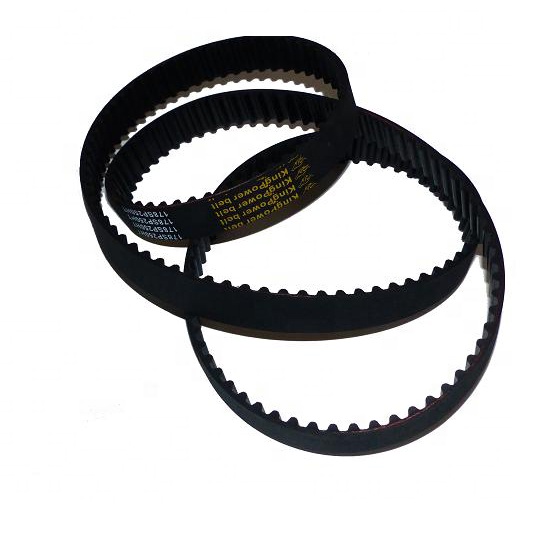
Industrial timing belts are mainly divided into rubber timing belts and PU (polyurethane) timing belts. They differ greatly in base material, operating performance, applicable working conditions and service life. Improper selection will reduce transmission accuracy and raise equipment maintenance costs significantly.
Rubber timing belts are generally made of neoprene with fiberglass tension cords. They feature excellent flexibility, outstanding impact resistance and great bending fatigue resistance, working stably at temperatures from -40℃ to 120℃. With low noise and good shock absorption, they perform well under heavy load, high speed and extreme temperature conditions. Their standard service life reaches 18,000 hours. They are widely applied in automotive transmission, textile machinery, papermaking equipment and large automated production lines. The main drawback is average wear resistance and slight dust generation during operation, making them unsuitable for clean workshops.
PU timing belts adopt polyurethane material with steel cord reinforcement. They own high rigidity and excellent dimensional stability. Their wear resistance is 5-8 times higher than rubber belts. Featuring great oil resistance, chemical resistance and dust-free operation, PU timing belts have a longer service life of up to 30,000 hours. However, they have poor flexibility and weak resistance to low temperature and strong impact. They are ideal for high-precision and dust-free scenarios, including food packaging, medical equipment, electronic automation and logistics sorting machines.
Quick Selection Guide: Choose rubber timing belts for heavy-duty and extreme temperature environments; pick PU timing belts for high-precision, oil-proof and dust-free working conditions.